
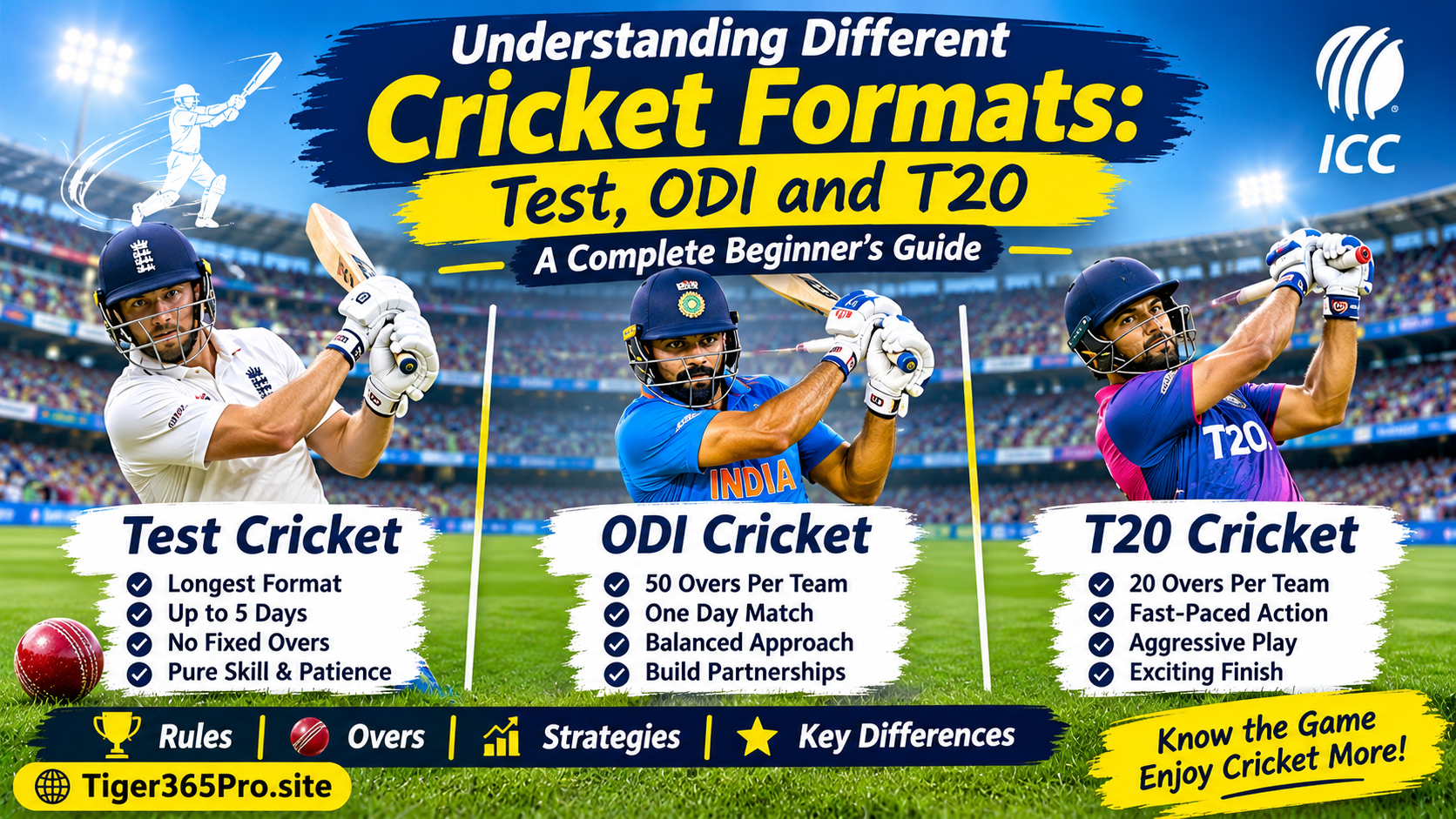
Understanding Different Cricket Formats: Test, ODI and T20 – A Complete Beginner’s Guide
Cricket is a sport enjoyed by millions of people across the world. From traditional five-day Test matches to exciting One Day Internationals (ODIs) and fast-paced T20 games, the sport offers different formats that create unique playing experiences.
If you are new to cricket, you may have noticed that not every match follows the same rules or duration. Some matches continue for several days, while others finish within a few hours. The number of overs, batting strategies, bowling plans, and match conditions also change depending on the format.
Understanding different cricket formats is important for anyone who wants to follow the game more closely. Each format has its own structure, challenges, and style of play. Test cricket focuses on patience and consistency, ODI cricket combines planning with controlled aggression, and T20 cricket encourages quick decision-making and fast scoring.
In this beginner-friendly guide, we will explain the three major international cricket formats: Test, ODI, and T20. We will explore their rules, match duration, overs, innings structure, strategies, scoring systems, and major differences.
Whether you are watching an international match, following a cricket tournament, or simply trying to improve your cricket knowledge, this article will help you understand how these formats work.
1. What Are the Different Formats of Cricket?
Cricket is played in several formats, but three major formats are recognised at the international level:
- Test Cricket
- One Day International (ODI) Cricket
- Twenty20 International (T20I) Cricket
Each format follows the basic Laws of Cricket, but the playing conditions differ. The biggest differences involve the number of overs, innings, match duration, and strategies used by teams.
According to the International Cricket Council (ICC), these three formats represent different styles of international cricket.
Let’s understand them individually.
2. Understanding Test Cricket
8
Test cricket is the traditional and longest format of international cricket. It is widely recognised for testing a player’s technical ability, patience, concentration, physical fitness, and mental strength.
The first recognised Test match was played between England and Australia in 1877. Since then, Test cricket has developed into an important part of international cricket history.
Unlike limited-overs formats, Test matches are generally scheduled across five days in men’s international cricket. Both teams usually have two innings to bat.
How Does Test Cricket Work?
In a standard Test match:
- Two teams participate.
- Each team normally has two innings.
- There is no fixed limit of overs for an innings.
- A match is scheduled for up to five days.
- Each day generally includes multiple sessions of play.
- The team scoring the required runs or achieving the necessary dismissals can win.
A team can bat until ten wickets fall, its captain declares the innings closed, or another applicable innings-ending condition occurs.
What Is an Innings in Test Cricket?
An innings is the period during which one team bats while the opposition bowls and fields.
In Test cricket, each team generally gets two opportunities to bat.
For example:
| Team | First Innings | Second Innings |
|---|---|---|
| Team A | 350 | 220 |
| Team B | 280 | 291 |
Team A’s combined total is 570 runs.
Team B’s combined total is 571 runs.
In this simplified example, Team B wins by one run, provided the match concludes with that result under the applicable playing conditions.
What Makes Test Cricket Different?
Test cricket places significant importance on technique and patience.
A batter may spend several hours at the crease to build a large innings. Instead of attacking every delivery, players often focus on defending good balls, identifying scoring opportunities, and maintaining concentration.
Bowlers also need different strategies. They may try to build pressure through consistent line and length, movement, spin, and changes in pace.
A bowler might not take a wicket immediately, but maintaining pressure can eventually create an opportunity.
Importance of Pitch Conditions
Pitch conditions play an important role in Test cricket.
The surface can change during a match because of weather, wear, moisture, and the number of deliveries bowled.
For example:
- A fresh pitch may provide assistance to fast bowlers.
- A dry surface may offer more help to spin bowlers.
- A worn pitch may develop cracks and uneven bounce.
- Weather conditions can influence swing and movement.
Teams must adapt their strategies as the match progresses.
What Is a Declaration?
A declaration is a decision made by the batting team’s captain to end their team’s innings voluntarily.
Captains usually declare when they believe they have scored enough runs and want to give their bowlers sufficient time to dismiss the opposition.
For example, Team A may declare at 450/7 rather than continuing to bat until all ten wickets are lost.
Declarations are an important tactical feature of Test cricket.
What Is a Follow-On?
A follow-on is a special rule in Test cricket that may allow the team batting first to ask the opposition to bat again immediately after its first innings.
It depends on the difference between the teams’ first-innings scores and the applicable match conditions.
For example:
- Team A scores 400 runs.
- Team B scores 180 runs.
- Team A has a substantial first-innings lead.
Depending on the match conditions and captain’s decision, Team A may enforce the follow-on.
This creates additional pressure on the team that is behind.
How Is a Test Match Won?
A Test match can finish in several ways:
Win: One team achieves the required result by scoring enough runs or dismissing the opposition according to the match conditions.
Draw: The scheduled match ends without a winning result, and the match does not meet the conditions for a tie.
Tie: Both teams finish with exactly equal totals in a completed match.
Test cricket is unique because a match can remain competitive even after several days of play.
3. Understanding One Day International (ODI) Cricket
CRICKET-IND-ENG-ODI
CRICKET-ICC-MENS-WC-2023-ENG-AUS-ODI
South Africa v India – 1st ODI
7
One Day International cricket, commonly called ODI cricket, is a limited-overs format where each team generally receives a maximum of 50 overs to bat.
ODI cricket was introduced at the international level in 1971. It became increasingly popular because it offered a shorter alternative to Test cricket while retaining a balance between batting and bowling.
An ODI match generally takes place over one day, although interruptions and competition-specific arrangements can affect the schedule.
How Does ODI Cricket Work?
The basic structure of an ODI match is:
- Two teams participate.
- Each team normally plays one innings.
- Each innings has a maximum of 50 overs.
- Each over consists of six valid deliveries.
- The team with the higher total generally wins.
- If the match is interrupted by weather, revised targets may apply under the relevant playing conditions.
The team batting first attempts to build a strong total. The second team then tries to reach that target within its allotted overs.
Understanding the ODI Innings Structure
ODI cricket can be divided into three broad strategic phases.
1. Powerplay Overs
The beginning of an ODI innings includes fielding restrictions that provide batters with opportunities to score boundaries.
The powerplay structure in standard men’s ODIs generally consists of three phases:
- Overs 1–10: Powerplay 1.
- Overs 11–40: Powerplay 2.
- Overs 41–50: Powerplay 3.
These phases have different fielding restrictions under the applicable playing conditions.
2. Middle Overs
The middle overs generally involve a balance between building partnerships and maintaining a healthy scoring rate.
Batters may rotate the strike, target suitable bowling matchups, and avoid unnecessary risks.
Bowlers often focus on controlling the run rate and creating wicket-taking opportunities.
3. Final Overs
The final ten overs are often called the death overs.
Batters usually try to accelerate scoring through boundaries, powerful shots, and smart running.
Bowlers attempt to limit the scoring by using yorkers, slower deliveries, variations, and accurate bowling.
What Is a Good ODI Score?
There is no single score that guarantees victory in ODI cricket.
The quality of a total depends on several factors:
- Pitch conditions.
- Ground dimensions.
- Weather.
- Opposition bowling strength.
- Tournament conditions.
- Team batting depth.
For example, a total of 270 runs may be competitive on a challenging surface, while a score of 350 or more may be needed on a high-scoring ground.
It is important to evaluate the match conditions instead of assuming that one fixed score is always sufficient.
How Does an ODI Match End?
An ODI match generally ends when:
- Both teams complete their innings.
- The chasing team reaches the target.
- A team loses all ten wickets.
- The allotted overs are completed.
- The match is affected by weather or another interruption.
If the scores are equal in a completed ODI, the match is tied. A Super Over may be used to determine the winner under the applicable tournament rules.
Major ODI Tournaments
Some important international ODI competitions include:
- ICC Men’s Cricket World Cup.
- ICC Women’s Cricket World Cup.
- ICC Champions Trophy.
- ICC Under-19 Cricket World Cup.
These tournaments bring together international teams and provide opportunities to compete at a high level.
4. Understanding Twenty20 (T20) Cricket
8
Twenty20 cricket, commonly known as T20, is the shortest of the three major international formats.
It was introduced to provide a faster version of the sport that could be completed within a few hours.
The first men’s Twenty20 International was played in 2005. Since then, the format has grown significantly in popularity.
T20 cricket is known for aggressive batting, innovative shots, fast bowling variations, athletic fielding, and exciting finishes.
How Does T20 Cricket Work?
A standard T20 International match follows these basic rules:
- Two teams participate.
- Each team receives one innings.
- Each innings has a maximum of 20 overs.
- Each over contains six valid deliveries.
- Each team normally has ten wickets available.
- The team scoring more runs wins, subject to match conditions.
The shorter format means players have less time to build an innings, making every over important.
Understanding T20 Powerplay
The first six overs of a standard T20 International innings are known as the powerplay.
During this period, fielding restrictions apply.
Batters often use the powerplay to score quickly because there are restrictions on the number of fielders allowed outside the designated fielding circle.
Teams may send aggressive opening batters to take advantage of these conditions.
However, losing early wickets can create pressure for the middle order.
Middle Overs in T20 Cricket
Overs 7–15 are commonly considered the middle phase of a T20 innings.
During this period, teams try to maintain the scoring rate while protecting wickets.
Batters may use:
- Quick singles and doubles.
- Sweeps and reverse sweeps.
- Controlled boundary shots.
- Innovative batting techniques.
Bowlers may use spin, slower balls, changes in length, and variations to control scoring.
Death Overs in T20 Cricket
The final overs of a T20 innings are often the most exciting part of the match.
Batters try to score as many runs as possible before their innings ends.
Bowlers may use:
- Yorkers.
- Slower deliveries.
- Wide lines.
- Short-pitched deliveries within applicable limits.
- Changes in pace and length.
A few deliveries can significantly change the final score.
What Is a Good T20 Score?
T20 scores vary depending on the ground, pitch, weather, and strength of the teams.
A score of 160 may be competitive in some conditions, while other grounds may regularly produce totals above 200.
For example:
- Team A scores 175/7 in 20 overs.
- Team B needs 176 runs to win.
- Team B reaches 176/5 in 19.3 overs.
Team B wins by five wickets.
This example demonstrates how quickly a T20 match can change during the final overs.
Popular T20 Cricket Tournaments
Some well-known T20 competitions include:
- ICC Men’s T20 World Cup.
- ICC Women’s T20 World Cup.
- Indian Premier League (IPL).
- Big Bash League (BBL).
- Pakistan Super League (PSL).
- Caribbean Premier League (CPL).
These competitions have helped introduce new audiences to cricket.
5. Key Differences Between Test, ODI and T20 Cricket
Although Test, ODI, and T20 cricket follow the basic principles of the sport, their match structures and strategies are different.
Here is a simple comparison.
| Feature | Test Cricket | ODI Cricket | T20 Cricket |
|---|---|---|---|
| Match duration | Up to 5 days in men’s Tests | Usually one day | Around 3 hours |
| Innings per team | 2 | 1 | 1 |
| Overs per innings | No fixed limit | 50 | 20 |
| Ball | Usually red; pink in day-night Tests | White | White |
| Clothing | Usually white | Coloured | Coloured |
| Batting approach | Patience and technique | Balanced approach | Aggressive scoring |
| Bowling approach | Building pressure over time | Control and variations | Accuracy and variations |
| Main focus | Endurance | Consistency and acceleration | Fast scoring |
| Common result | Win, loss, draw or tie | Win, loss or tie | Win, loss or tie |
General comparison. Specific playing conditions, including women’s matches, domestic competitions, weather adjustments and tournament rules, may differ.
The ICC provides official information about the three formats and their playing conditions. You can refer to the ICC Playing Conditions and Regulations for detailed rules.
6. Difference in Batting Strategies Across All Three Formats
Batting is one of the most important aspects of cricket, but the approach changes depending on the format.
Batting in Test Cricket
Test batters generally focus on:
- Maintaining a strong defensive technique.
- Playing according to the match situation.
- Building long partnerships.
- Avoiding unnecessary risks.
- Understanding the behaviour of the pitch.
A batter may score 100 runs after facing more than 200 deliveries. This can be an extremely valuable contribution in Test cricket.
Batting in ODI Cricket
ODI batting requires a balance between patience and aggression.
Players generally focus on:
- Building partnerships.
- Maintaining a consistent run rate.
- Rotating the strike.
- Taking advantage of powerplays.
- Accelerating towards the end of the innings.
A successful ODI innings often requires batters to change their approach as the game progresses.
Batting in T20 Cricket
T20 batters usually focus on scoring quickly.
Common strategies include:
- Attacking from the beginning.
- Finding gaps in the field.
- Playing innovative shots.
- Targeting favourable bowling matchups.
- Maximising the final overs.
However, aggressive batting does not mean playing every delivery carelessly. Good shot selection and situational awareness remain important.
7. Difference in Bowling Strategies
Bowling strategies also change depending on the format.
Test Bowling
Test bowlers generally aim to create pressure over longer periods.
They may focus on:
- Consistent line and length.
- Swing and seam movement.
- Spin and turn.
- Changes in pace.
- Building pressure through repeated deliveries.
A bowler may bowl long spells while trying to dismiss a batter who has spent several hours at the crease.
ODI Bowling
ODI bowlers must balance wicket-taking with run prevention.
They need to manage different phases of the innings and adapt to fielding restrictions.
Some bowlers focus on early breakthroughs, while others specialise in controlling the middle overs or bowling at the end.
T20 Bowling
T20 bowling requires quick decisions and precise execution.
A bowler may use different deliveries to prevent batters from scoring boundaries.
Yorkers, slower balls, cutters, and changes in pace are common tactical options.
The ability to handle pressure is especially important because even one expensive over can affect the result.
8. Role of Fielding in Different Cricket Formats
Fielding is an essential part of all three cricket formats.
However, the importance of certain fielding skills changes depending on the number of overs and match situation.
In Test cricket: Fielders focus on maintaining pressure, supporting bowlers, and taking catches over long periods.
In ODI cricket: Fielders must balance boundary protection with attacking positions and saving runs during different phases.
In T20 cricket: Quick movement, athletic catches, direct hits, and boundary-saving efforts can have a major impact on the result.
A single run-out or boundary-saving effort can change the direction of a close match.
9. What Are Powerplays in Limited-Overs Cricket?
Powerplays are periods in limited-overs cricket when restrictions apply to the placement of fielders outside the designated fielding circle.
They are designed to create opportunities for scoring while maintaining a balance between batting and bowling.
ODI Powerplay
In standard men’s ODI conditions, powerplays are divided into three phases:
- First 10 overs.
- Overs 11–40.
- Final 10 overs.
Different fielding restrictions apply during these periods.
T20 Powerplay
In standard T20 International conditions, the powerplay covers the first six overs.
The batting team often attempts to score quickly, while the bowling team tries to take early wickets.
Powerplays are one reason why limited-overs cricket has a different tactical structure from Test cricket.
10. Understanding Tie, Draw and No Result
These three terms are often misunderstood by beginners.
What Is a Tie?
A tie occurs when both teams finish with exactly the same score in a completed match.
A tie can happen in Test, ODI, and T20 cricket.
In limited-overs tournaments, a Super Over may be used to determine the winner, depending on the competition regulations.
What Is a Draw?
A draw is most commonly associated with Test cricket.
It occurs when the scheduled match ends without either team achieving a win or a tie.
For example, if five days of a Test match finish and neither team has achieved a winning result, the match may end in a draw.
What Is No Result?
A no-result match occurs when circumstances such as rain or other interruptions prevent a valid result from being achieved under the relevant playing conditions.
This term is frequently seen in limited-overs cricket.
Understanding these terms helps readers interpret cricket match results more accurately.
11. Major International Cricket Tournaments
Different cricket formats have their own international tournaments. These competitions allow teams to compete against each other and demonstrate their skills.
Australia wins World Test Championship Final, defeating India at The Oval – ABC News
ICC World Test Championship
A competition involving leading Test-playing nations. Teams earn points through a series of Test matches, with the top two qualifying for the final.
World Cup 2023: Pat Cummins’ Australia do an Australia in a very un-Australian way | Cricket
ICC Cricket World Cup
One of the most recognised ODI tournaments, bringing together international teams to compete for the world title.
ICC T20 World Cup
An international tournament featuring teams competing in the shortest major international format.
Apart from these competitions, various countries organise domestic leagues and tournaments that follow similar format structures.
12. How Technology Has Changed Modern Cricket
Technology has become an important part of modern cricket. It helps officials make decisions, supports performance analysis, and provides viewers with more detailed match information.
Some commonly used technologies include:
Decision Review System (DRS)
The Decision Review System allows teams to challenge certain on-field umpiring decisions under the applicable competition rules.
It uses available technologies to help review decisions such as LBW and certain boundary or catch situations.
Hawk-Eye
Hawk-Eye technology is used in cricket for ball-tracking analysis. It helps assess the predicted path of the ball and supports certain umpiring reviews.
Ball-Tracking and Broadcast Graphics
Modern broadcasts display information such as:
- Ball speed.
- Wagon wheels.
- Pitch maps.
- Scoring zones.
- Run rates.
- Player statistics.
These features make cricket easier to understand for viewers.
Digital Scorecards
Online scorecards provide updated information about runs, wickets, overs, partnerships, and player performances.
They allow cricket followers to check match progress even when they cannot watch the entire game.
However, viewers should always use reliable sources when checking official match results and statistics.
13. Which Cricket Format Is Best for Beginners?
There is no single format that is best for everyone. It depends on how much time someone has and what type of cricket they enjoy.
Here is a simple comparison.
| Your Preference | Suitable Format |
|---|---|
| Enjoying traditional cricket | Test |
| Watching balanced competition | ODI |
| Following short and exciting matches | T20 |
| Learning batting technique and patience | Test |
| Understanding different match phases | ODI |
| Enjoying quick results and aggressive play | T20 |
If you are completely new to cricket, T20 can be a convenient starting point because matches are shorter and easier to follow.
After understanding the basics, you can explore ODI cricket to learn more about partnerships, powerplays, and innings management.
Test cricket is also worth watching because it provides a deeper understanding of bowling, batting technique, pitch conditions, and match strategy.
Each format offers something different, and following all three can improve your overall knowledge of cricket.
14. Common Mistakes Beginners Make When Understanding Cricket Formats
People who are new to cricket sometimes misunderstand how the different formats work.
Here are a few common mistakes and their explanations.
Mistake 1: Thinking every cricket match has 20 overs
Not all cricket matches are T20 games. ODIs generally have 50 overs per side, while Test cricket has no fixed innings-over limit.
Mistake 2: Assuming Test matches always finish in five days
Five days is the scheduled duration of a men’s Test, not a guarantee that the match will last the entire period. Some matches finish earlier.
Mistake 3: Thinking the same batting strategy works everywhere
A batter’s approach should depend on the match format and situation. A defensive approach may be useful in Test cricket, while a faster scoring rate is often important in T20 cricket.
Mistake 4: Ignoring bowling restrictions
Limited-overs cricket has specific restrictions on how many overs an individual bowler can deliver. These differ from Test cricket.
Mistake 5: Confusing a draw with a tie
A draw and a tie are different results. A draw means no winning result was achieved, while a tie means both teams finished with equal scores in a completed match.
Mistake 6: Comparing scores without considering the format
A total of 300 runs has a very different meaning in Test cricket, ODI cricket, and T20 cricket.
Understanding the format before evaluating a score is important.
15. Why Learning About Cricket Formats Is Important
Understanding cricket formats gives viewers a better perspective on how the sport works.
It helps people follow international competitions, understand match situations, and appreciate the different skills required from players.
Some important benefits include:
- Better cricket knowledge: Understand the basic structure and rules of different formats.
- Improved match understanding: Follow innings, overs, and scoring patterns more confidently.
- Player performance analysis: Understand why batting and bowling strategies change.
- Tournament awareness: Identify which format is used in major cricket competitions.
- Better scorecard interpretation: Understand why totals and statistics vary across formats.
- Informed cricket discussions: Participate more confidently in conversations about matches and tournaments.
Learning these basics can make watching cricket more interesting, especially when following international teams and major competitions.
16. Following Cricket Information Through Online Platforms
The internet has made cricket information more accessible than ever. Cricket enthusiasts can explore match summaries, player statistics, tournament updates, historical records, and general sports-related articles through digital platforms.
When using an online cricket information website, readers should pay attention to the quality and accuracy of the information.
A few useful practices include:
- Check whether the match details are current.
- Verify results through recognised cricket score providers.
- Understand the difference between official statistics and opinions.
- Read tournament rules before interpreting unusual match situations.
- Avoid relying on unsupported claims about players or teams.
Readers interested in cricket-related online content can also explore Tiger365Pro.
Always evaluate website information independently, particularly when a platform discusses services involving financial participation. Check applicable laws and understand the risks before engaging with any such service.
Cricket is best enjoyed through knowledge, sportsmanship, and responsible participation.
17. Frequently Asked Questions (FAQs)
1. What are the three main formats of international cricket?
The three main international formats are Test cricket, One Day International (ODI) cricket, and Twenty20 International (T20I) cricket.
2. How many overs are played in Test cricket?
Test cricket does not have a fixed number of overs per innings. The match is generally scheduled for up to five days in men’s international cricket.
3. How many overs are played in ODI cricket?
A standard ODI innings has a maximum of 50 overs per team, unless the innings ends earlier or playing conditions provide for adjustments.
4. How many overs are played in T20 cricket?
A standard T20 International innings has a maximum of 20 overs per team.
5. What is the main difference between Test and ODI cricket?
Test cricket generally has two innings per team and can last up to five days. ODI cricket has one innings per team with a maximum of 50 overs.
6. Why is T20 cricket shorter than ODI cricket?
T20 cricket gives each team a maximum of 20 overs, while ODI cricket allows up to 50 overs per team. This shorter structure makes T20 matches faster.
7. Which cricket format is the longest?
Test cricket is the longest major international cricket format. Men’s Test matches are generally scheduled across five days.
8. Which cricket format is the shortest?
T20 International cricket is the shortest of the three major international formats, with each team receiving up to 20 overs.
9. What is a powerplay in cricket?
A powerplay is a period in limited-overs cricket when specific fielding restrictions apply. It creates opportunities for batters to score runs and encourages attacking play.
10. What is the difference between T20 and T20I?
T20 is the general name for the 20-over format. T20I stands for Twenty20 International, which refers to an officially recognised international match played between eligible national teams under ICC regulations.
11. Can a Test match end in a draw?
Yes. A Test match can end in a draw when the scheduled match concludes without either team achieving a win or a tie.
12. Can an ODI match end in a tie?
Yes. An ODI match can end in a tie when both teams finish with equal scores. Tournament rules may provide for a Super Over to determine the winner.
13. What is the difference between a red ball and a white ball?
Red balls are traditionally used in Test cricket, while white balls are generally used in limited-overs international cricket. Day-night Test matches may use a pink ball.
14. Which format requires the most patience from players?
Test cricket generally demands significant patience, concentration, and endurance because matches continue over several days.
15. Why are there different formats of cricket?
Different formats offer different playing experiences. Test cricket focuses on endurance and technique, ODI cricket balances planning and scoring, while T20 cricket offers a shorter and faster version of the sport.
Conclusion
Test, ODI, and T20 cricket are three important formats that make the sport enjoyable in different ways.
Test cricket represents the traditional side of the game, where patience, technique, and endurance play a major role. ODI cricket provides a balance between careful batting and aggressive scoring, while T20 cricket offers fast-paced action and exciting finishes.
Although the basic principles remain similar, each format requires different strategies from batters, bowlers, captains, and fielders.
Understanding the number of overs, innings structure, powerplays, match duration, and scoring methods can help beginners follow cricket more confidently.
Whether you enjoy watching a five-day Test match, an exciting ODI competition, or a high-scoring T20 game, learning the differences between these formats will make your cricket experience more meaningful.
For additional cricket-related reading and online content, visit Tiger365Pro.site.
Continue exploring the game, learning its rules, and following reliable cricket information to develop a better understanding of this popular international sport.