
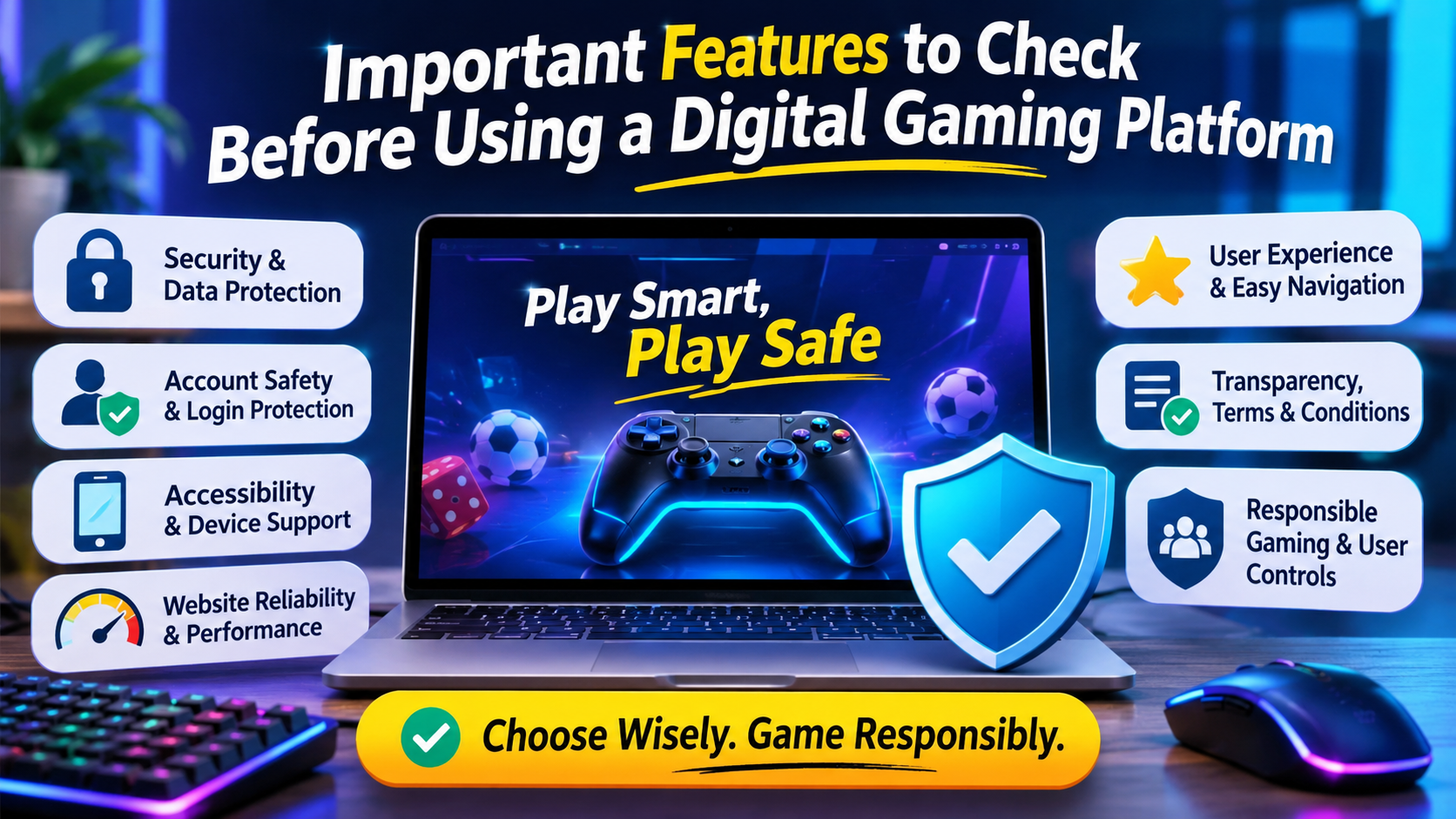
Important Features to Check Before Using a Digital Gaming Platform
Explore important digital gaming platform features, including security, account safety, accessibility, website reliability and responsible gaming. Choosing a digital gaming platform is not just about finding a website with attractive graphics or different gaming categories. A good online experience also depends on security, privacy, accessibility, technical performance and clear information. Before using any gaming website, it is important to understand how the platform works, what information it collects and whether its services follow the rules applicable in your location. These checks can help you make informed decisions instead of relying only on advertisements or recommendations.
Online gaming websites have different purposes. Some focus on casual entertainment, others provide esports information, and some may offer services involving financial transactions. Each category comes with different considerations. A platform that looks professional does not automatically mean that its services are secure, trustworthy or legally permitted. Taking a few minutes to examine its policies and available information can help you avoid unnecessary risks.
In this guide, we will explore the important digital platform features that users should examine before accessing an online gaming service. We will also discuss website reliability, account protection, mobile accessibility and responsible gaming, with reference to the publicly available information on tiger365pro.
Why Choosing the Right Digital Gaming Platform Matters
The quality of an online gaming experience depends on more than the number of games available. When users visit a website, they expect a smooth interface, understandable information and reliable access to its features. If the website takes too long to load, displays unclear terms or makes it difficult to find customer support, the overall experience can quickly become frustrating. This is why evaluating a platform before using it is an important part of responsible internet usage.
A well-organised digital gaming platform should make its purpose clear. Visitors should be able to understand the services being offered, the eligibility requirements and the conditions that apply to different features. Important information should not be hidden behind complicated navigation or unclear language. Users should also have access to relevant privacy information and account protection guidance before sharing personal details.
Understanding Your Online Gaming Requirements
Every user has different expectations when visiting an online gaming website. Some people are interested in sports information, while others prefer casual digital entertainment or competitive esports. Understanding your purpose helps you identify which features are actually relevant instead of being distracted by unnecessary options. For example, a person looking for sports schedules may prioritise accurate event information and easy navigation, whereas someone exploring a casual gaming website may focus more on device compatibility and accessibility.
It is equally important to distinguish between entertainment services and platforms that involve financial stakes. Financial involvement introduces additional legal, privacy and personal financial risks. Users should understand the exact nature of a service before creating an account or providing information. Checking eligibility, age restrictions and local regulations should always come before exploring account-related features. A website’s appearance or popularity should never replace these basic checks.
The Importance of a Safe Digital Environment
A safe digital environment gives users clear information about how a website operates and how their information is handled. This includes secure login procedures, transparent privacy policies, accessible support channels and understandable terms of service. These features are important because online accounts can contain personal information that users would not want exposed to unknown individuals.
A responsible platform should also explain how users can report suspicious activity, manage their accounts and seek help when something goes wrong. Safety is not a single feature that can be judged by looking at a homepage. It involves several technical and operational practices working together. Users should therefore examine the available information carefully before deciding whether a website meets their expectations.
1. Gaming Platform Security and Data Protection
Gaming platform security should be one of the first things users consider when evaluating an online service. Every time someone visits a website, registers an account or submits information, there may be privacy and security considerations. A secure-looking interface alone cannot prove that a website has strong security controls. Users need to examine the website address, connection security, privacy policy and information about how personal data is collected and protected.
A trustworthy service should explain what information it requests and why that information is necessary. It should also provide understandable details about data storage, sharing, retention and account deletion where applicable. If a website requests unnecessary personal information without explaining its purpose, users should treat that as a warning sign. Protecting personal information starts with knowing exactly where it is being submitted.
Secure Website Connections and Encryption
One basic technical feature to check is whether a website uses HTTPS. The HTTPS connection helps encrypt information exchanged between a browser and a website, reducing the risk of interception while data is being transmitted. Visitors can generally identify this connection by checking the browser address bar and confirming that the domain is spelled correctly.
However, HTTPS should not be treated as proof that a website is genuine or trustworthy. Even fraudulent websites can obtain HTTPS certificates. Therefore, users should also examine the domain name, website ownership information, contact details and independent reputation. Avoid opening login pages through unfamiliar advertisements, shortened links or random messages. Entering sensitive information on an imitation website can expose account credentials even when the page looks similar to a legitimate service.
Privacy Policies and Personal Information
A privacy policy explains how a website handles information submitted by visitors and registered users. Before using a digital gaming platform, read this document to understand whether the service collects names, email addresses, phone numbers, device information or other personal details. Look for information about third-party sharing, data retention and the procedures available if you want to request access to or deletion of your information.
The language should be reasonably clear. If the privacy policy is missing, incomplete or difficult to understand, it becomes harder to assess how the website handles personal data. Users should avoid sharing identity documents, financial information or sensitive account details unless there is a legitimate, clearly explained and legally appropriate reason. Good privacy practices are an important part of a safer online gaming experience.
2. User Account Safety and Login Protection
An online account can become a target if its login information is weak or shared with other people. That is why user account safety deserves special attention when evaluating any digital gaming website. A platform should communicate its account requirements clearly and provide suitable methods for protecting user access.
Before registration, check whether the website explains its login process, password requirements, account recovery procedures and available security settings. It should also be clear how users can contact support if they notice unfamiliar activity. Never assume that an account is protected simply because the registration process asks for a phone number or email address.
Strong Passwords and Account Verification
A strong password is one of the simplest ways to improve personal account security. Avoid predictable combinations such as your name, birth date, phone number or common number sequences. Instead, use a long, unique password that is not shared with other websites. A reputable password manager can help create and store complex passwords without requiring you to remember every combination.
Where supported, multi-factor authentication adds another layer of protection. According to the OWASP Multifactor Authentication guidance, effective MFA uses independent authentication factors rather than simply asking for two versions of the same password. Users should prefer secure authentication methods and avoid sharing verification codes with anyone. An OTP received on your phone should never be disclosed to someone claiming to be a customer support representative. OWASP Cheat Sheet Series
Recognising Suspicious Account Activity
Users should understand how to recognise possible account security problems. Unexpected login notifications, password reset messages that they did not request, unfamiliar devices and unexplained account changes may indicate suspicious activity. If something unusual happens, change the password using the verified website and follow the provider’s official account recovery procedure.
Be particularly careful with messages promising special access, guaranteed benefits or urgent account verification. Scammers often create a sense of urgency to encourage people to click unknown links or disclose sensitive information. Genuine support procedures should never require you to reveal your password or banking authentication codes. A platform’s security information should explain how account problems are reported and what steps users can take to protect themselves.
3. Platform Accessibility and Device Compatibility
A good platform accessibility experience means that users can understand and navigate a website without unnecessary difficulty. People visit digital gaming websites using different devices, screen sizes and internet connections. A website that works only on a desktop computer may create difficulties for visitors who prefer smartphones or tablets.
Before using a platform, examine its layout on the device you normally use. Important information should remain readable, menus should be easy to access and essential links should work properly. Accessibility is not simply about appearance. It also includes how comfortably users can interact with the website.
Mobile-Friendly Design and Navigation
Mobile compatibility is an important feature because many people access websites through smartphones. A responsive design adjusts page layouts according to screen size, helping users read content and navigate without constantly zooming in or scrolling horizontally. Buttons should have enough space for touch interaction, and important information should remain visible on smaller displays.
However, a mobile-friendly homepage does not automatically guarantee that every feature works correctly on mobile devices. Users should check whether individual pages, login sections, support information and other website functions are accessible. It is also useful to see whether the website behaves consistently across commonly used browsers. A smooth mobile experience should make information easier to access rather than encourage users to overlook important terms and conditions.
Accessibility for Different Users
Accessibility should consider people with different abilities and browsing requirements. Readable font sizes, sufficient colour contrast, descriptive navigation labels and keyboard-friendly controls can make a website easier to use. Clear headings also help visitors understand the page structure and find relevant information without reading every section.
Websites should avoid unnecessary visual distractions and confusing interface elements. Important notices, privacy information and safety guidance should be easy to locate. Users who depend on assistive technologies may also benefit from properly labelled controls and meaningful page structure. These details contribute to a more inclusive digital experience and demonstrate that usability involves more than attractive design.
4. Website Reliability and Technical Performance
Website reliability refers to how consistently a website works when visitors access its pages and features. A platform may have an attractive interface, but frequent errors, broken links or unexpected downtime can affect its usability. Before trusting a digital service, users should examine whether its main pages load correctly and whether its published information is available consistently.
Reliability is especially important when websites handle user accounts or personal information. Unexpected technical failures can create confusion about account access and support procedures. A website should provide understandable information about service interruptions and maintenance wherever possible.
Website Loading Speed and Stability
Loading speed influences how easily visitors can use a website. Pages that take too long to open may discourage users from exploring the available information. Slow performance can also make navigation difficult on mobile connections. A well-optimised website generally uses efficient page structures, appropriately sized images and properly configured technical resources.
Users can perform simple checks by opening different sections of the website and observing whether pages load consistently. Look for broken buttons, missing images, repeated error messages and pages that redirect unexpectedly. A website that loads quickly once is not necessarily reliable over time. Consistency across different visits is a better indicator of its technical usability.
Updates, Maintenance and Technical Support
Regular maintenance helps website operators identify technical problems and keep services functioning correctly. Visitors should look for clear maintenance notices, updated information and working support channels. If the website publishes outdated terms or contains links that no longer work, users may struggle to understand which information is current.
Technical support is another important consideration. A service should explain how users can report website errors or account access problems. Contact information should be verifiable, and support instructions should not ask visitors to share passwords or confidential authentication codes. Before using a service, check whether its help information is clear enough to understand what to do if a technical issue occurs.
5. User Experience and Platform Navigation
User experience brings together the different elements that make a website comfortable or difficult to use. It includes navigation, content organisation, readability, page consistency and the ease of finding important information. A well-structured digital gaming platform should allow visitors to understand its sections without unnecessary confusion.
Menus should use clear labels, and important information should not be buried under unrelated pages. Users should be able to locate privacy policies, terms of service, eligibility details and support information without spending excessive time searching. Clear descriptions are also important because they help visitors understand what a particular section contains before opening it.
Another useful feature is consistency. Similar pages should follow a predictable layout, and buttons should behave as visitors expect. Unnecessary pop-ups, misleading advertisements and confusing redirects can make a website difficult to navigate. Users should also be cautious if a page repeatedly pressures them to register or submit information before they can read basic service conditions. A good interface should support informed decisions rather than rush visitors into taking action.
6. Transparency, Terms and Conditions
Transparency is one of the most important qualities to examine before using an online service. A website should clearly explain who operates it, what services it provides, what restrictions apply and how users can contact the responsible organisation. If important business or service information cannot be verified, users should avoid assuming that the website is legitimate.
Read the terms and conditions before creating an account. Pay attention to age requirements, geographical restrictions, account responsibilities, service limitations and dispute procedures. If the website offers any financial features, the applicable terms and local legal requirements become especially important. Do not rely on promotional statements or third-party recommendations as proof of legality.
For users in India, there is an additional legal consideration. The Promotion and Regulation of Online Gaming Act, 2025 prohibits online money games, including those based on skill, chance or a combination of both. The associated Promotion and Regulation of Online Gaming Rules, 2026 came into force on 1 May 2026. These rules also establish requirements relating to user safety, transparency and grievance procedures for covered services. Users should understand the distinction between permissible esports or online social games and prohibited online money gaming. Press Information Bureau+2
A website’s availability does not establish that every service it mentions is legally permitted. This is particularly important when reviewing websites associated with sports and online gaming. Always check current Indian regulations and applicable restrictions before considering any service.
7. Responsible Gaming and User Controls
Responsible gaming is an important part of a safer online environment. Digital entertainment should not interfere with essential responsibilities, personal finances, education, work or relationships. Users should understand the potential risks of services involving financial stakes and avoid treating gaming as a reliable source of income.
Useful safety measures include age verification, time restrictions, parental controls, reporting tools and accessible information about potential risks. The Indian government’s 2026 online gaming framework identifies user safety features such as age-related safeguards, time restrictions, parental controls and grievance mechanisms. Press Information Bureau+1
Before using any gaming-related service, examine whether it explains the risks and provides practical ways to manage access. If a website involves financial activity, never use money required for household expenses, education, savings or other essential needs. Avoid using a service when it creates stress, encourages excessive spending or affects your daily routine. Responsible digital behaviour starts with understanding your limits and respecting applicable laws.
How to Evaluate a Digital Gaming Platform Before Using It
Evaluating a website does not require advanced technical knowledge. Even an ordinary visitor can perform several basic checks before deciding whether a digital service is suitable. The important thing is to look beyond the homepage and examine the information that explains how the website operates. A few careful observations can help identify missing details, unclear policies and potential security concerns.
Here are some practical areas to review:
- Check the website address: Make sure the domain is spelled correctly and that you are visiting the intended website. Avoid unknown links received through messages or advertisements.
- Review security information: Check for HTTPS, privacy policies, password guidance and available account protection options.
- Understand the services: Identify whether the website provides casual entertainment, esports information, social gaming or services involving financial stakes.
- Read the terms and conditions: Understand age restrictions, geographical eligibility, account rules and other service limitations.
- Test website accessibility: Open different pages using your smartphone and desktop browser to check whether the layout and navigation work properly.
- Find customer support: Look for genuine contact details, complaint procedures and account assistance information.
- Check legal compliance: Confirm that the services are permitted under the laws applicable to your location.
These checks provide a starting point for evaluating an online service. They do not guarantee that a website is safe, but they help users make more informed decisions.
What Should Users Check on Tiger365 Pro?
The publicly accessible website of Tiger365 Pro presents information about sports categories, online gaming content, mobile-friendly browsing and account-related guidance. Its homepage also mentions cricket, football, tennis and basketball as sports categories. Tiger365 Pro
WEBSITE REFERENCE
Tiger365.pro Review: Is It Safe? (85/100 Trust Score)
Tiger365 Pro
Sports and digital entertainment informationVisit the website
Visitors considering this website should independently review its terms, privacy policy, eligibility conditions and applicable legal restrictions before sharing personal information. They should also verify the identity of the actual service operator and look for independently verifiable security and licensing information.
Importantly, the website itself states that its published information does not verify the operator’s licence, financial practices, security controls or the availability of particular services. Therefore, its homepage should not be treated as proof of regulatory approval or security certification. Tiger365 Pro
This distinction matters. A website may describe useful interface features, but users still need independent evidence before trusting account services or sharing sensitive information. In India, any service involving online money games must also be assessed in light of the applicable 2025 Act and 2026 Rules.
Common Warning Signs to Avoid
Some warning signs deserve immediate attention when evaluating a digital gaming website. These include missing terms and conditions, unclear ownership details, suspicious login links, misleading promotional messages and requests for unnecessary personal information.
Be particularly careful when a website or an individual promises guaranteed earnings, risk-free financial returns or special access in exchange for sharing account credentials. Such statements should not be accepted without independent verification.
Other warning signs include:
- No clear privacy policy or contact information.
- Repeated redirects to unrelated websites.
- Unexplained requests for OTPs or banking credentials.
- Unclear age and location restrictions.
- No understandable complaint or account recovery process.
- Pressure to provide sensitive information immediately.
If you encounter these issues, do not proceed simply because the website looks professional. Stop and verify the information independently.
Conclusion
Choosing a digital gaming platform requires more attention than simply checking its design, gaming categories or available features. Security, account protection, privacy, accessibility, website reliability and transparent policies all contribute to a better-informed online experience. Users should also understand the purpose of a website and distinguish between entertainment, esports and services involving financial stakes.
Before using any platform, check its authenticity, read its terms and conditions, review its privacy practices and verify whether its services are legally permitted in your location. Websites such as Tiger365 Pro can be examined through their publicly available information, but descriptions of features should not be confused with independent verification of security, licensing or regulatory compliance.
Ultimately, a responsible digital experience begins with informed choices. Take time to understand the website, protect your personal information and prioritise your online safety over promotional promises.
Frequently Asked Questions (FAQs)
1. What is a digital gaming platform?
A digital gaming platform is an online website or application that provides access to gaming-related content and services. Depending on its purpose, it may include casual games, esports information, sports-related content or social gaming features. Users should understand the services offered and their applicable conditions before accessing a platform.
2. Which features should I check before using an online gaming platform?
Check website security, account protection, privacy policies, mobile compatibility, website reliability, customer support and transparent terms and conditions. Also verify age restrictions and local legal requirements. These checks help users understand the website before sharing personal information.
3. Why is gaming platform security important?
Gaming platform security helps protect user accounts and personal information from unauthorised access. Secure website connections, strong passwords, multi-factor authentication and clear account recovery procedures are useful security measures. Users should also avoid sharing OTPs and login credentials with other people.
4. Is Tiger365 Pro accessible on mobile devices?
The publicly accessible Tiger365 Pro website describes a responsive browsing layout intended to adapt to mobile phones, tablets and desktop screens. However, visitors should independently test the accessibility and functionality of individual website sections. Tiger365 Pro
5. Are all online gaming platforms legal in India?
No. The legal position depends on the type of service and applicable regulations. India’s Promotion and Regulation of Online Gaming Act, 2025 prohibits online money games, and the associated 2026 Rules came into force on 1 May 2026. Users should verify whether a particular service is legally permitted before accessing it. MeitY+1